Daniel Firak, SBU RAU Organizer


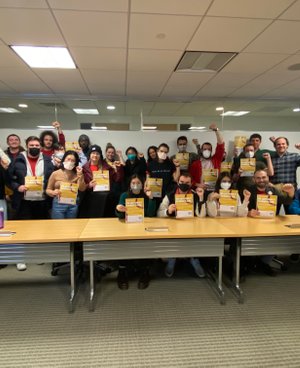
On January 28, 2026, Research Assistants Union (RAU) at Stony Brook University had their contract ratified in a major victory: a contract mostly without concessions, and a raise of 50% to the base salary over a span of 30 months! This was the result of a long fight that we describe below for our readers.


Research Assistants in the State University of New York System are employed by the SUNY Research Foundation (RF), a private non-profit that manages federal grants. This strange arrangement of privately hired researchers for a state university caused plenty of disruption and miscommunication, leading the bargaining to take over two years to be fully finalized.


The first bargaining session was on January 24, 2024, where a small team of researchers from the organizing team of the RAU, together with representatives and lawyers from the CWA, met with the RF’s bargaining team – a hodge podge of RF lawyers and representatives from both the RF and SBU campus. From the beginning, it was clear that the RAU team would have their work cut out for them: with so many variables in the equation, and with NY State, RF, and SBU all shifting responsibility to each other, holding the RF accountable for their work was the main challenge.


Continue >>

Editorial

On February 19th, 2026, the Graduate Student Employees Union conducted a public panel with the name “Fascism and Working Class Struggle.” The panel description read as the follows:


“Following Max Horkheimer's insight "Whoever is not willing to talk about capitalism should also keep quiet about fascism," in his latest book Late Fascism, Alberto Toscano writes ‘Whoever is not willing to talk about anti-capitalism should also keep quiet about anti-fascism.’

Continue >>

Doğa Öner

In New York State, The Taylor Law (Public Employees' Fair Employment Act) prohibits strikes for all public sector employees. The law also includes other comprehensive measures discouraging collective action and aims at disarming workers from what has proven historically to be the most significant form of direct action by workers and unions. To advance a more effective and radical labor movement, it’s imperative for all public employees in NYS, including SUNY workers, to understand this law, its historical development and applications.


It is unsurprising that strikes are the primary target of anti-worker policies. Strikes are not only powerful weapons for attaining demands for workers in workplaces, they also have the potential to reveal essential workplace structures and relations to workers and the general public. According to the ideological/natural view under capitalism, bosses, entrepreneurs, innovators, and owners of companies are indispensable, those who create and drive the wealth of workplaces and societies. Workers, conversely, are insignificant, dispensable, replaceable; parts of production that do not really matter. For the worker as an individual, this view has a reality; production seems independent, something existing without and against them. However, strikes reverse this situation; they advance a class standpoint from which the productive structure that seemed to work on its own and by virtue of the management is seen to be sustained and reproduced by workers.

Continue >>

Preston Carter, Business Agent of FGSW-CWA 1104


This article considers the difficulties of winning and enforcing our first contract at Fordham and what the union learned from addressing them.


For members of the Education Division of CWA 1104, Fordham University is unique in its Catholic and Jesuit identity. In the context of higher education labor organizing, particularly interesting are the contradictions and paradoxes of the University’s performative commitment to Catholic Social Teaching in juxtaposition to its union-busting and anti-union practices.


Catholic Social Teaching involves basic commitments regarding the right of working people to engage in mutual aid and form unions, etc. There is not supposed to be anything particularly difficult about accepting this teaching, nor is it considered to position the Catholic church politically.


Nonetheless, while most of the lower and upper administration would not hesitate to speak highly of Fordham’s commitment to social justice, it became clear that the performance demanded by the institution does not include adhering to Catholic Social Teaching when it comes to work as such (which includes The Dignity of Work and the Rights of Workers). Instead, Fordham as an institution promoted rather than refrained from union busting to the point of enacting Unfair Labor Practices that violated basic Section 7 Labor Rights.


Continue >>

Editorial


Trump, MAGA, and the oligarchs behind them have cut taxes for the rich and paid for it with cuts to healthcare and food assistance. They are scheming to undermine the rest of our social safety net, to rig the economy and undermine our elections. ICE agents are in our streets and at our airports.


This era of crisis can be an era of growing working-class solidarity and union expansion, if we rise to the occasion and organize. Marches and rallies are incredibly important, and the PSC has mobilized large numbers of members to turnout. But we know they might not be enough to stop the slide into authoritarianism. That’s why May Day Strong organizers working with unions across the country are planning a strategic escalation: a day of no work, no school, no shopping.

Continue >>

Editorial

Labor for Palestine was launched in April 2004 by New York City Labor Against the War and Al-Awda NY: The Palestine Right to Return Coalitionto reclaim the legacy of rank-and-file working class solidarity with Palestinein the United States, as reflected in groundbreaking statements by the League of Revolutionary Black Workers in 1969, and wildcat strikes against the United Auto Workers (UAW) leadership’s support for Israel in 1973.


LFP endorses the 2005 Palestinian-led Boycott, Divestment and Sanctions (BDS) picket line, which demands an end to occupation and apartheid, full equality for all, and Palestinian refugees’ right to return to the homes and lands from which they were expelled.


This includes support for calls from Palestinian trade unions, the Congress of South African Trade Unions (COSATU), and other trade unionists around the worldto refuse to handle Israeli cargo, and calling on labor bodies to divest from Israel Bondsand cut ties with the Histadrut, Israel’s racist labor federation.


Continue >>

Doğa Öner

Some of the biggest blows to labor come as attacks in the name of freedom; the decision in Janus v AFSCME (“Janus”) that prevents public unions from collecting dues (including our union), the attacks on closed-shop by the name of “right-to-work,” or the insistence on the uninfringeable management rights on the rule of the shopfloor. Precarious and unsafe gig work, likewise, is presented as realizing freedom, autonomy, and independence.


Mark Reiff, in his In the Name of Liberty, observes that in the face of attacks on workers in the name of freedom, labor has not been able to respond on the same dimension, has retreated from the ideal of freedom, and has focused on concepts like equality, equity, and workplace security. (Reiff 2020, 6) Without denying the importance of the latter, we can argue that the inability of labor to tackle the issue of freedom is to our grave disadvantage. A serious approach to freedom from the perspective of the working-class is an indispensable task to set labor on a more radical path, counter attacks we face, and confront our immediate problems from a different perspective. A working-class conception of freedom is key for the ideological, strategic, and ethical clarity labor requires today.


Continue >>

Preston Carter, Business Agent of FGSW-CWA 1104

The crisis that gave rise to the Emergency Workplace Organizing Committee (EWOC) did not end with COVID. In fact, it didn’t start and was never confined to the pandemic. As Zachary Gelnaw-Rubin, a new co-chair of EWOC NYC Local, puts it, “"COVID was an epic emergency that brought the day-to-day emergencies of work to the surface.” What EWOC names as emergencyis, in fact, the ordinary condition of contemporary work: declining real wages, rising precarity, administrative expansion, and a deepening imbalance of power between workers and institutions. The emergency of EWOC turns out not to be COVID but economic crisis and war on workers.


Nowhere is the emergency clearer than in higher education. The university has long relied on a fiction: that it is a workplace unlike any other. Graduate workers are framed as apprentices or interns, adjuncts as contingent professionals, and undergraduates as majorly students, even when they are performing essential labor that sustains the university. These distinctions do not simply describe reality or aid resolution; they actively obscure it and offer objections. They isolate workers, fragment grievances, and delay the development of collective power.

Continue >>

Editorial


The following letter was written by an international graduate worker in CWA 1104 and shared anonymously out of concern for their safety amid the escalating assault on immigrants and international workers. It has since been read aloud in multiple public forums: by Mike Ippoliti, President of CWA Local 1104 (who debuted the letter in full in an Emergency Town Hall by District 1), by Preston Carter at a New York City rally for international workers, and again at the public delivery of the Fordham Graduate Student Workers’ sanctuary campus petition. The editorial board wishes to share it with the readers of the New York Graduate Worker.

Continue >>

Aritra Chatterjee

Interfering with our country’s foreign policy? Sure as hell are!…

…That’s our job. That’s our privilege. That’s our right. And that’s our duty.” These are the words of Harry Bridges, founding president of the International Longshore Workers’ Union (ILWU) which represents longshore workers on the US West Coast. He had been asked about the ILWU’s support and leadership of work stoppages in the late 1930s. First, San Francisco dockworkers refused to load food onto an Italian ship after fascist Italy invaded Ethiopia. A few years later, ILWU workers would refuse to load scrap metal onto a Japanese ship after Japanese imperialist aggression on China. Skirting the limits of what was legal under their union contracts, they joined thousands of Chinese American community members on the picket lines, facing not just police repression but also employers and federal arbitrators weaponizing labor law against them. They were also met with disapproval from President FDR, often viewed as an ally of labor, for “interfering in the good diplomatic relationships between two nations”. 


In 1940, FDR would be forced to order an embargo on scrap iron exports to Japan. Looking back on these struggles 30 years later, Bridges would say, “Why, that’s what unions are for, to help make foreign policy in the interest of the majority of people in this country and other countries.”

Continue >>

In the labor movement, on May Day and every day, arises the wish for what we call “bread and roses.” That is, not just the means to secure bare life and sustenance, but also the means to partake in the beautiful things in life. Admittedly, I too wish for these things, but not without a skepticism of what wish fulfillment and attachments do to us. What happens after the roses wilt? Will its thorns scratch and tear us apart to reveal irresolvable pain, more than skin deep? What do we lose sight of in our pursuit of flowery yet fungible joys?


I recently came across a dystopian trend in my social media algorithm, one that continues the trend of millennial economic hopelessness and despair. Rather than the millennial grievances around the impossibility of home ownership, it turns out that gen Z can hardly imagine even renting their own apartments. “One day, you’ll be shopping for groceries to cook dinner in a small apartment that you rent,” the posts read.1How did things turn out this way? Forget the roses – we’re now romanticizing the bread that becomes a garlic bread and spaghetti dinner. (Delicious? Yes. Middle-class? No.) The floor keeps changing on what we consider to be rosy and romantic, and it has fallen from home ownership to mere apartment renting. Are we now settling for romanticizing bare life? This is not what “bread and roses” should come to mean in the 21st century.

Continue >>

The New York State College of Ceramics Graduate Student Workers Union (NYSCC-GSU) is excited to share that we have ratified our first contract! The NYSCC-GSU was organized during the spring of 2024 through a joint effort between graduate student workers in the two halves of the College of Ceramics: The School of Art and Design and the Inamori School of Engineering.


Continue >>

The State University of New York is the largest comprehensive network of public universities in the United States. SUNY proudly claims this superlative, noting that its campuses—sixty-four schools and thirty community colleges—are embedded in nearly every community across the state. Impressively, this means that “93 percent of New Yorkers live within 15 miles of a SUNY campus, and nearly 100 percent live within 30 miles.”[i]Add to this the fact that SUNY is a postwar institution—established only in 1948 compared to, for instance, the University of California in 1868. One may be led to believe that New York State has made remarkable progress in cultivating and providing public higher education.


Recent developments in education across the United States, however, beg a reassessment of New York’s feat, and of US public higher education in general. When I first drafted this text in the summer of 2023, the ongoing crises in the US education system included conservative politicians’ frightening regulation and rescripting of curricula, investment in and pursuit of the humanities declining at an alarming rate, and insurmountable student debt for which recent forgiveness programs were ruled unconstitutional. The severity and exacerbation of these threats hang in the balance as I revisit and revise this text three days before the 2024 presidential election.


Continue >>

Kit L. Lâm, GSEU Buffalo Business Agent


CWA Local 1104 is growing at an unprecedented rate: in the last year, over 1,000 research assistants in Binghamton, Albany, and Buffalo voted overwhelmingly to unionize, joining existing SUNY Research Assistants Unions at Stony Brook and the College of Environmental Science and Forestry. Research assistants in the SUNY system are employed by the SUNY Research Foundation, a private corporation that administers and manages externally funded grants and contracts. The privatization of research in SUNY meant that thousands of graduate workers across the state did not have union representation - after the latest wave of organizing, this is no longer the case. With a 99% YES vote in Buffalo, and 98% in Albany and Binghamton, RAs at every university center have now joined Local 1104. These historic victories, led by research assistants in tandem with staff organizers from the local, district, and GSEU, dramatically increase grad worker power in New York.

Continue >>

David Harris, Colleges Business Agent


Annika Blake-Howland, Chair of Bargaining Committee

GSEU’s new contract, ratified on June 10, 2025, was an important victory for graduate workers in SUNY. However, with the retroactive nature of the contract (July 2023 - July 2026), and its implementation at SBU being uncharitable, inconsistent, and not infrequently plain wrong, TAs and GAs here have been engaged in a constant struggle against underpayment. There are also plenty of examples of blatant wage theft that can very easily go unnoticed by the worker and GSEU alike. Relying on the mass activity of workers, and actively taking up cases of underpayment even when they involved non-members, SBU GSEU has secured an out-of-contract campus minimum raise, has been able to fight back against wage theft, and has seen our membership grow to around 72%. We have also actively partnered with undergraduate groups on campus and RAU in the Sanctuary Campus campaign, and developed an active political education committee in CWA 1104 Education Division.

Continue >>

Universities are no longer just spaces of learning; they are increasingly sites of surveillance. What was once imagined as a place for open inquiry and intellectual freedom is now shaped by data tracking, monitoring systems, and quiet cooperation with state authorities. Nowhere is this shift more visible than in the lives of immigrant and international students, whose presence on campus is defined not only by education but by constant scrutiny. For migrant students—especially those who are undocumented or navigating unstable visa conditions—this surveillance carries serious consequences, extending beyond academic discipline to the risks of detention, deportation, or loss of legal status. This surveillance rarely announces itself and instead operates quietly through routine administrative systems and federal databases that track students’ movements and legal status. Though framed as necessary and benign, these practices reveal a deeper reality where universities are not passive or neutral institutions, but active participants in a broader infrastructure of control.

Continue >>

SUNY GeneseoSUNY Geneseo apparently fills mental health counseling GA positions with graduate students enrolled at the University of Rochester. Currently enrollment as a graduate student at a SUNY school is not required by the state to be considered eligible for the position, merely being enrolled as a graduate student anywhere. This feels counter to the spirit of the positions

Continue >>